

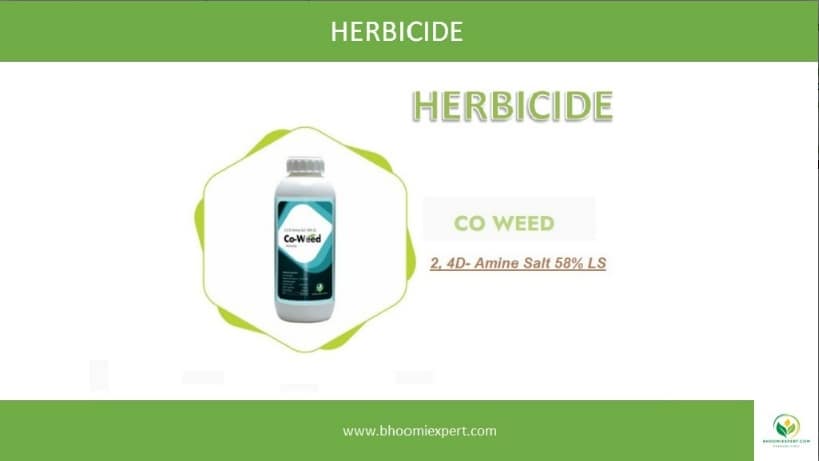
CO- WEED
Price range: ₹200.00 through ₹400.00
2,4-D is a selective, systemic herbicide used to control broadleaf weeds in a variety of crops, turf, and aquatic environments. It works by mimicking the plant growth hormone auxin, which causes uncontrolled growth and eventually leads to the death of susceptible plants. Available in different formulations like amine salts and esters, 2,4-D is applied as a spray and is not effective against grasses.
-
Growth mimicry:
2,4-D is a synthetic plant hormone that disrupts the normal growth process of broadleaf plants.
-
Uncontrolled growth:
It causes a massive, uncontrolled increase in cell division, leading to stem and leaf twisting, and abnormal growth.
-
Plant death:
This process ultimately results in the death of the weed, often within 48 hours, as the plant’s cell membranes are damaged.
-
Selective action:
It is selective, meaning it kills broadleaf weeds without harming grasses like corn or wheat.
- Amine salts: Are water-soluble and absorbed by plant roots and foliage.
- Esters: Are oil-based and penetrate foliage more easily. Some ester formulations can be more volatile and more toxic to aquatic life.
- Control of annual and perennial broadleaf weeds.
- Used in agriculture, forestry, and aquatic weed management.
- Can be used in a variety of crops, including sugarcane, wheat, maize, and potato.
- Used on turf and lawns.
- The U.S. EPA has concluded that the data is not sufficient to establish a cause-and-effect relationship between 2,4-D exposure and cancer, though its carcinogenicity classification has varied over time.
- Commercial formulations can be irritating to the eyes and skin.
- Ester forms can be highly toxic to fish and other aquatic life.
- The human body eliminates most absorbed 2,4-D in the urine within a few days.
- The toxicity depends on the specific chemical form (e.g., salt or ester) and concentration.
| SIZE | 1LITER, 400ML |
|---|
Related products
-
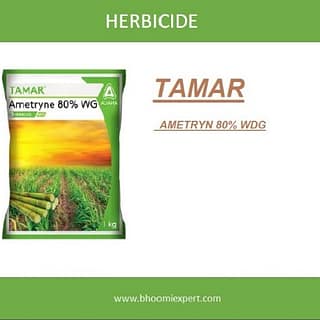
TAMAR
Price range: ₹650.00 through ₹1,300.00Select options This product has multiple variants. The options may be chosen on the product pageGeneral Info
Tamar is a new selective early post herbicide on Sugarcane which has broad spectrum activity on grasses and broad leaved weeds.
Tamar belongs to the s-triazines chemical group which inhibits Photosynthetic reaction in weeds.
Tamar has both foliar and soil activity. By this it kills the existing weeds & the new emergence from weed seeds. It is compatible with 2, 4-D.
Tamar shall be applied when Sugarcane weeds are at 2-4 leaf stage. It provides longer duration of weed control.
It protects sugarcane from early slow growth of sugarcane tillers from weed competition.
Tamar is available in the pack sizes of 50g, 100g, 250g, 500g, 1kg and 5kg.
-
GLYPHOCURE
Original price was: ₹650.00.₹420.00Current price is: ₹420.00.Select options This product has multiple variants. The options may be chosen on the product pageGlyphosate 41% SL is a non-selective, systemic herbicide that kills all types of weeds, including annual and perennial grasses and broadleaf weeds, by disrupting their growth through the inhibition of a key plant enzyme. The “SL” stands for soluble liquid, indicating it is a liquid formulation designed to be dissolved in water and sprayed onto the foliage …
Reviews
There are no reviews yet.